You close your mouth, but your front teeth still do not touch. That visible space between the upper and lower teeth is known as an open bite, a bite problem that can affect eating, speech, and the way your smile looks.
Open bites can develop because of childhood habits, tongue position, tooth eruption, or jaw growth. At Barlow Orthodontics, we identify what is contributing to the problem before recommending treatment, which may include braces, clear aligners, or other orthodontic approaches.
Understanding the cause helps us determine the right way to correct the bite and support a stable, functional result.
What Is an Open Bite?
With a typical bite, the upper front teeth overlap the lower front teeth slightly when the back teeth come together. In an anterior open bite, the back teeth may touch while a visible space remains between the upper and lower front teeth. A posterior open bite occurs farther back in the mouth, where certain back teeth fail to make normal contact.
The size of the opening does not always indicate how significant the problem is. A relatively small open bite can still interfere with biting certain foods or affect speech. For this reason, orthodontists evaluate the entire bite rather than focusing only on the visible gap between the teeth.
An examination may include the position of individual teeth, the relationship between the upper and lower jaws, facial growth, tongue posture, and oral habits. Digital imaging and other orthodontic records can also help determine whether the open bite is primarily dental, skeletal, or a combination of both.
What Causes an Open Bite?
There is no single cause of every open bite. Some develop because of habits during childhood, while others are related more closely to genetics, jaw growth, tooth eruption, or tongue function. In many patients, several factors contribute at the same time.
Identifying these factors matters because the cause can influence both the type of treatment and its timing. It can also help an orthodontist determine whether additional steps are needed to reduce the likelihood of the bite opening again after treatment.
Thumb Sucking and Pacifier Habits
Persistent thumb, finger, or pacifier sucking can influence the developing teeth and jaws. When a thumb, finger, or pacifier regularly sits between the upper and lower front teeth, it may interfere with normal tooth eruption and contribute to an anterior open bite.
These habits are common in young children and do not automatically mean a child will need orthodontic treatment. The duration, frequency, and intensity of the habit all matter. If the habit continues as permanent teeth begin to erupt, its effect on the developing bite may become more significant.
Stopping the habit early enough may allow some improvement as the child grows. If an open bite remains, an orthodontic evaluation can help determine whether treatment is appropriate and when it should begin.
Tongue Position and Swallowing Patterns
Tongue posture can also play a role in some open bites. If the tongue frequently rests between the upper and lower teeth or pushes forward during swallowing, it may contribute to forces that affect tooth position.
This is sometimes described as a tongue-thrust pattern, but the relationship between tongue function and an open bite can be complex. The tongue may contribute to the problem, or its position may be influenced by the existing bite. That is why a complete evaluation is more useful than assuming one particular habit is responsible.
Depending on the patient, orthodontic treatment may need to address both tooth position and contributing functional patterns. In selected cases, care may involve collaboration with another qualified healthcare professional.eth Faster?
Jaw Growth and Genetics
Some open bites have a stronger skeletal component. The way the upper and lower jaws grow can create a vertical relationship that makes it difficult for the front teeth to overlap normally. Genetics can influence these facial and jaw growth patterns.
Skeletal open bites can be more complex than open bites caused mainly by tooth position. In growing children, an orthodontist may be able to use the remaining growth as part of the treatment strategy. In adults, treatment options depend on the severity of the jaw relationship, the patient’s goals, and how much correction is possible through orthodontic tooth movement.
This distinction is one reason two patients with similar-looking open bites may receive very different treatment recommendations.
How Is an Open Bite Corrected?
Open bite treatment is based on the cause, severity, age of the patient, growth pattern, and position of the teeth and jaws. There is no single appliance or treatment method that is appropriate for everyone.
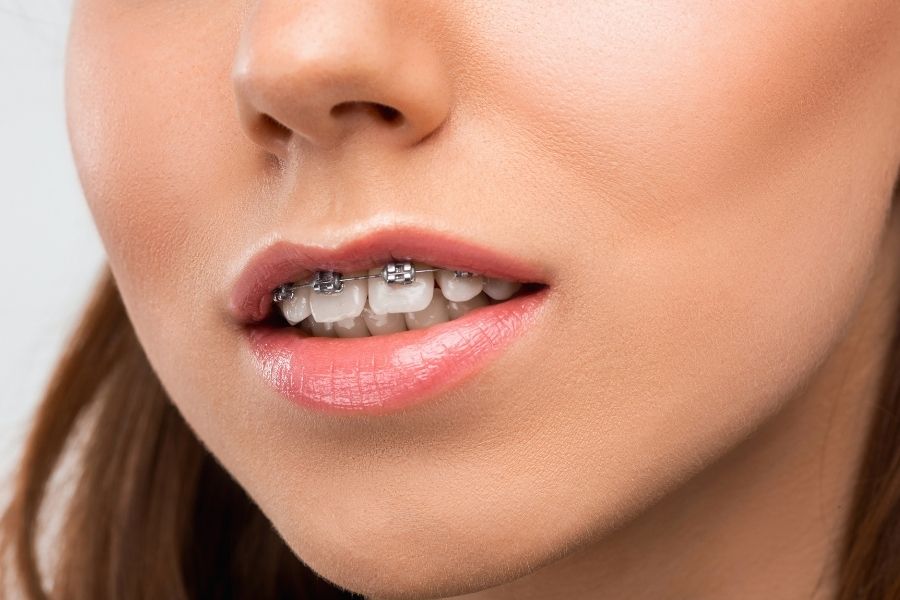
Braces can be used to move teeth into positions that improve how the upper and lower arches fit together. Clear aligners may also be an option for certain teenagers and adults, depending on the movements required and the complexity of the bite. Successful aligner treatment requires patients to wear the appliances as directed.
For younger patients with an ongoing oral habit, addressing that habit may be an important part of treatment. Certain orthodontic appliances may be considered when a child needs additional help discontinuing a habit or when tooth and jaw development requires guidance. Timing is especially important because treatment decisions can change as a child grows.
More significant skeletal open bites in adults can require a different approach. Some can be improved with orthodontic treatment alone, while severe jaw discrepancies may require orthodontics combined with orthognathic, or corrective jaw, surgery. A detailed examination is necessary before determining whether surgical treatment should even be considered.
Why Early Orthodontic Evaluation Can Be Helpful
An open bite does not always need to be treated as soon as it appears. Young children are still growing, primary teeth are being replaced, and certain oral habits may resolve. However, an orthodontic evaluation can help parents understand whether the bite should simply be monitored or whether early orthodontic treatment could be beneficial.
The American Association of Orthodontists recommends that children have their first orthodontic checkup no later than age 7. At this age, an orthodontist can evaluate developing permanent teeth and observe how the jaws and bite are growing.
Early evaluation does not necessarily mean early braces. In many cases, the appropriate recommendation is continued observation. When intervention is indicated, identifying a developing problem at the right stage may provide treatment options that would be different after growth is complete.
Can an Open Bite Come Back After Treatment?
Long-term stability is an important consideration with open bite correction. Teeth naturally experience forces from the lips, cheeks, tongue, chewing, and everyday oral function. If a contributing habit or functional pattern remains after orthodontic treatment, it may affect the stability of the result.
Retention is therefore an important part of orthodontic care. After active treatment, patients are typically instructed to wear retainers according to their orthodontist’s recommendations. The specific type and schedule depend on the individual case.
Good long-term results also depend on addressing contributing factors whenever possible. Following retention instructions and attending recommended follow-up visits can help protect the improvements achieved during treatment.
Open Bite Treatment in St. Marys, Georgia
An open bite can be caused by tooth position, childhood habits, tongue posture, jaw growth, genetics, or a combination of factors. The appropriate correction depends on understanding which of those factors are affecting the individual patient.
At Barlow Orthodontics in St. Marys, we provide orthodontic care for children, teens, and adults from St. Marys, Kingsland, Camden County, Yulee, Nassau County, and surrounding communities. Our approach is centered on careful diagnosis, personal attention, and treatment recommendations based on each patient’s needs.
If you are concerned about an open bite in yourself or your child, an orthodontic consultation can provide a clearer picture of what is happening and whether treatment is recommended. Our goal is to help every patient understand their options and make an informed decision about their orthodontic care.